Outer Banks septic guide
Beach chair setup and breakdown service, explained
Daily setup and breakdown is a different product from a weekly drop: a crew places the gear each morning and strikes it each evening. What it solves, who it suits, and where it is available.
Setup and breakdown is the concierge tier of beach-gear rental, and it is frequently misunderstood as a convenience upgrade when it is really a compliance product. A crew arrives at a fixed access in the morning, places your chairs and umbrella in the same spot every day, and comes back in the evening to take everything down and carry it off the sand. You never move the gear, never anchor an umbrella, and never have to remember what time your town says the beach has to be clear. That last item is the one most people are actually buying.
The details
The service exists because every oceanfront jurisdiction on this coast has a nightly clear-the-beach rule and the hours are not the same in any two of them. A family renting for a week has to learn one town's deadline, remember it after a long day in the sun, and physically drag a loaded cart back over a dune to meet it. A setup crew turns that into somebody else's scheduled task. Nothing about the underlying rule changes — the gear still has to come off — but the obligation moves to a company whose entire route is built around meeting it.
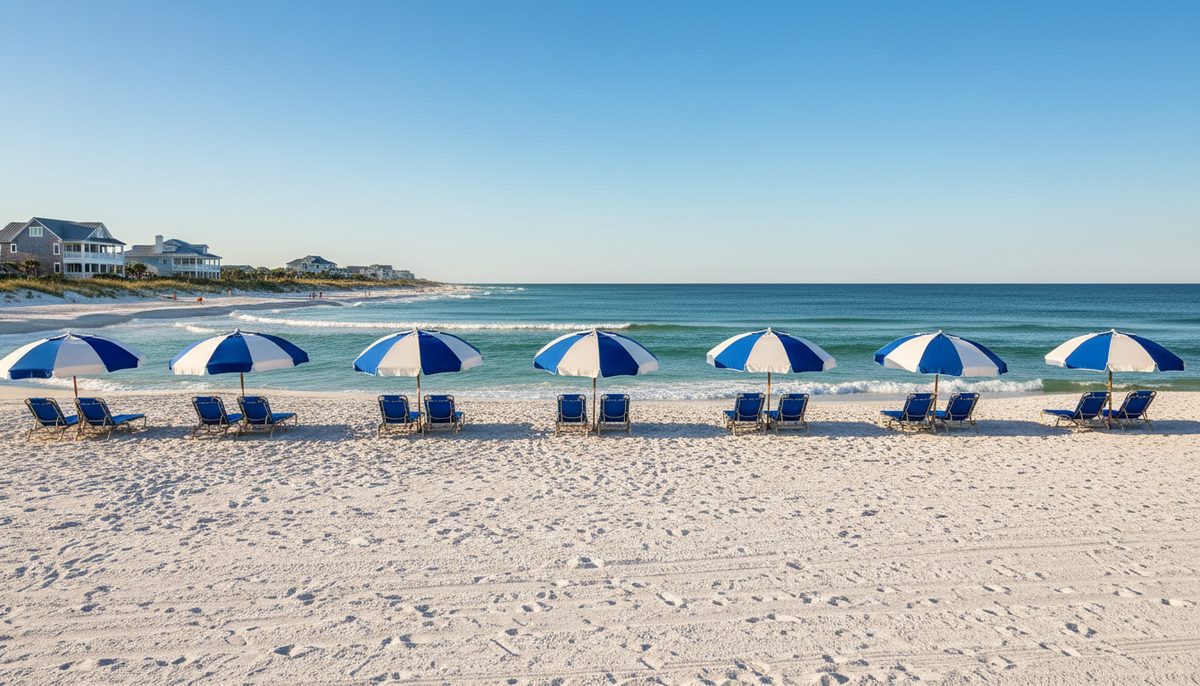
Mechanically, the crew works accesses rather than houses. They arrive early, walk in from a public access or an oceanfront property, and build the setups in a line along a stretch of beach they cover every day. Your set is identifiable, usually by colour or by a numbered tag, and it sits in roughly the same place each morning so you can find it from the top of the dune. In the evening the same crew comes back down the line and strikes everything in one pass. This is why availability is geographic and often quite narrow: a company can only sell the service where it has a crew walking, so a house two miles outside the coverage line genuinely cannot buy it at any price.
The anchoring is the part that is worth money and gets no credit. An umbrella that has been screwed into wet sand to the correct depth, tilted into the wind rather than straight up, and re-set when the breeze swings in the afternoon will hold a day that sends an amateur setup cartwheeling down the beach. Crews do this several hundred times a season and they are good at it. An umbrella that gets away from you in a crowded July surf zone is not a comic moment, it is a metal spike travelling at speed, and the single strongest argument for professional placement is that it does not happen.
Placement is also a rules decision, not a taste decision, and the Park Service's own summary of it holds everywhere on this coast: shade is essential - but towns regulate where it goes. Every town here writes some version of the same requirement: equipment must not obstruct a lifeguard's view of the water or block the lane an emergency vehicle uses on the sand. A crew that works a stretch daily knows where the stands sit and where the driving lane is, and they build the line accordingly. It is worth noting how much guarded water there is to work around — the National Park Service staffs five lifeguarded beaches, Memorial Day-Labor Day, and the Dare County towns run their own separate programs on top of that.
Who should buy it: anyone with small children, anyone with a mobility limitation, multi-family groups who want one anchored basecamp rather than four scattered ones, and anyone whose house is a long or awkward walk from the sand. Who should not: a couple who wants to fish one morning, drive to Hatteras the next and sit on the soundside the third. The service is priced and scheduled around a fixed daily spot, and if your week is a moving target you are paying for a stake in the ground you will not use.
Two things to confirm before you book, because they vary by operator and they are the source of most disappointment. First, what happens on a day you do not go to the beach — is the setup built anyway, and do you pay for it? Second, what happens in weather: crews generally will not put umbrellas up in high wind, and a rained-out week is a real risk on a coast where the market runs across 110 miles of Dare County shoreline and a squall can sit over one village and miss the next entirely. Ask both questions in writing.
You are not buying a chair. You are buying somebody else's early morning, somebody else's anchoring skill, and somebody else's problem at the end of the day. For the right party — young children, a long dune crossing, a group that wants one place to meet — it is the most useful money spent on the whole trip.
On the record: shade is essential - but towns regulate where it goes (OBX Beach Access - Outer Banks Beach Canopies & Equipment Laws (obxbeachaccess.com, secondary summary, retrieved 2026-09-17)) · 110 miles of Dare County shoreline (Dare County Emergency Management - Beach Hazards (darenc.gov, retrieved 2026-09-17)) · five lifeguarded beaches, Memorial Day-Labor Day (NPS - Lifeguarded Beaches, Cape Hatteras National Seashore (nps.gov, retrieved 2026-09-17))
Hand-verified 2026-09-17 against the primary sources named above; where a fact could not be verified it was left out, never guessed.